

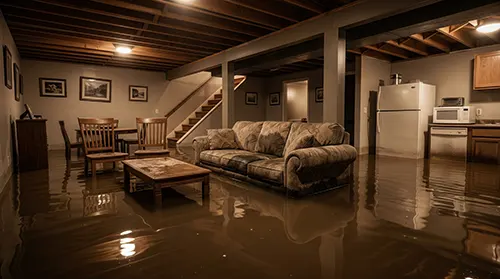
So you invited your buddies over for your monthly poker game in your man cave in the basement. You go downstairs to get everything set up and you find a small lake. Looks like the game is screwed but now what do you do? Adam explains.
Narrator: It's time once again for the crack man podcast. Hosted by A1 Foundation crack repair. I'm Darren Kincaid, and I'm here with the crack daddy himself, Adam Tracy. Adam has 20 years of experience in the construction industry and as a civil engineer is A1 foundation's resident engineer on staff, solving a plethora of unique foundation problems every day. This podcast provides expert basement waterproofing, concrete repair, and preventative maintenance tips for homeowners and businesses. A1 Foundation's valuable insight will help revert the disaster of a flooded basement, health problems with water infiltration, and protect your biggest investment, your home. The topic of today's podcast: Water is pouring into my finished basement. Now what?
Adam: So Adam, you invite your buddies over for your monthly poker game in your man cave in the basement. You go downstairs, get everything set up, and you find a small lake. Looks like the game is screwed, but now what do you do?
Yeah, it's not fun for anyone, including everyone that's about to step into the basement and have wet socks. So, no, this is the challenge with people who have finished their basements or have bought a home with a finished basement.
When you have a finished basement, you can't see the foundation, and that's kind of by design, right? We don't want to live in a dark, cold, musty basement. We want a finished room downstairs.
The challenge is, when you have a water issue, it becomes much more difficult to hunt down and figure out what is going on. So the first step in any situation where you are having water coming in is try to document what you have when it's happening, because when you have somebody come out to take a look at it, it might be a beautiful, dry day, and all of that water is gone, and you can't tell exactly what's happening, right?
You'd have to open up a wall, you'd have to get a moisture meter in there, but having videos or photos of the event when the event happens is critical to help understanding from our end how to help you.
When you are having water coming in, the first thing I would say besides documenting what's going on there is to go look outside, right? It's a free look to see what is happening on the exterior.
We had a customer call us the other day. We had a flash rain event where they had about 2 inches of rain over about a 30-40 minute period in a heavy thunderstorm, and it overwhelmed the gutter system and flooded the basement door.
They had just a couple steps that went down and they had water in the basement. They had no idea where it was coming from. They just panicked and they went outside and they saw that the gutters were totally overrun, they were clogged, and all of that water was collecting at the basement door.
The basement door just couldn't keep the water out, and so it got underneath. So that's an easy repair, but it wouldn't be a foundation repair, it's more about your gutters.
Sometimes when you're having a water event, and it's in an isolated area, you want to see, okay, if this isn't the entire basement, where is this coming in? It's all a 3-foot area, but it's on the floor.
So a lot of times we'll get the homeowner saying, "Well, it's only coming at the bottom of the wall, so it must be where the floor and the wall meet." And that doesn't always necessarily mean it's true, because you could have a crack in the wall, and as water flows down the wall, it's going to hit the floor, and it's going to come out the bottom.
Doesn't always present on the actual wall, because the water doesn't always squirt out of the foundation crack. Sometimes it just bleeds down the wall.
So with these situations, you want to look on the outside. Is there a crack on the outside? Is there a flaw in the foundation that you can visually see above ground that may be contributing to this?
Sometimes the grade of the soil or your mulch beds or your garden beds are so high, the water's getting up and over the foundation. That'd be another thing to look at.
And at the end of the day, when you're having water coming into a finished basement, honestly, the best thing to do after you've collected yourself, cleaned up what you can, is you have to open up the wall.
It doesn't have to be torn down, you don't have to start from scratch, but you do have to start somewhere. And typically you want to start in the area where the water is coming in, not only to find out how is this water coming in, but you want to make sure that you're not getting mold and mildew and any sort of microbiological growth happening behind the wall, and that can happen fairly quickly.
That's why we have all these restoration companies throughout Massachusetts, Rhode Island, New Hampshire, that basically go around to help people out with this.
Whether it's a small mom-and-pop shop or a big national brand, they'll open up the walls and dry it out a little bit.
So these are things that you can do to really get ahead of the situation and be able to understand, because when we don't know, we're also going to rely on the experience that you had during this rain event to be able to determine what the best course of action is.
And I tell customers that the more you know, and the more you understand this water situation and how it came in, the less you end up paying because we can really target the area, versus really kind of overreaching because we're not exactly sure exactly how it's coming in.
So, do yourself a favor, go outside, document, and then unfortunately, you're probably going to have to open up a wall to be able to determine the true cause of it.
The last thing that you need to do is to understand what kind of rain event it was, and kind of categorize that in your mind.
Was this a thunderstorm that rolled in on an afternoon and you got 2 inches of rain and water came in, or is this a sustained rain event where we had inches of rain over a 3-5 day period where you had constant rain and it kind of really saturated the soil?
Because if you're getting water after 3 or 4 days of rain, it's a very different approach than if you get water on a very big flash flood event, because it tells us that deep in the soil is supersaturated, and now you are looking at more of like sump pump type solutions versus it's coming in through a crack and it's really just a flaw in the foundation that needs to be repaired.
So, hopefully you have a good road map after this, and you can kind of figure out where to start.
If you don't have that and you're a little concerned still, give us a call, we can help guide you through the process, tell you when we're best to come in and help you out.
Feel free to call us anytime.
Thanks, Adam, for explaining what to do when you find water pouring into your finished basement.
Narrator: If you have a basement water problem and think you need a professional, or if you'd like more information on foundation crack repair and basement waterproofing topics, please visit A1foundationcrackrepair.com or call Adam at (866) 929-3171, or you can email Adam at info@a1foundationcrackrepair.com. Thanks for listening, and keep that basement dry.