

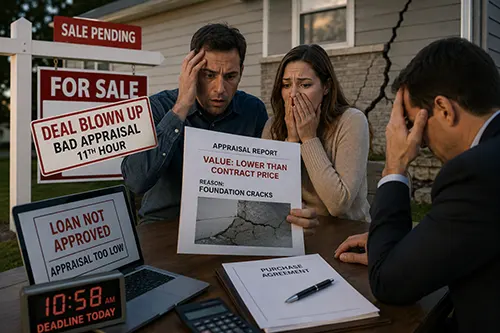
A1 Foundation Crack Repair gets a lot of calls from real estate agents in an absolute panic because they received a bad appraisal due to a foundation wall or floor crack. What typically happens in cases like that when you get those calls? Adam explains.
Narrator: It's time once again for the Crackman Podcast, hosted by A1 Foundation Crack Repair. I'm Darren Kincaid and I'm here with a crack daddy himself, Adam Tracy. Adam has 20 years of experience in the construction industry and as a civil engineer is A1 Foundation's resident engineer on staff, solving a plethora of unique foundation problems every day. This podcast provides expert basement waterproofing, concrete repair and preventive maintenance steps for homeowners and businesses. A1 Foundation's valuable insight will help avert the disaster of a flooded basement, health problems and a water infiltration and protect your biggest investment, your home. The topic of today's podcast: Did your real estate deal blow up in the 11th hour because of a bad appraisal due to foundation cracks?
Narrator: So Adam, you seem to get a lot of calls from real estate agents in an absolute panic because they received a bad appraisal due to a foundation wall or floor crack. What typically happens in cases like that when you get those calls?
Adam: Well, it's not usually a good situation for any party involved because everyone's been working for weeks or even months to get to the date where ownership changes hands, one family moves out, and another family moves in. In some cases, the deals are contingent upon closing another property, so it becomes a very sticky situation. It's a lot of stress for everyone involved, primarily because it completely adjusts the timeline in a way that no one anticipated.
I'll give you an example. This was a property in Boxborough, Massachusetts, not too far from our home base. It had a standard 1995 concrete foundation with a small settlement crack in the foundation wall. The crack came up on the inspection report as a required maintenance item, and we had already provided pricing and recommended repair methods. Overall, it was a very straightforward repair—something we've been doing for more than 35 years and something we handle every single day. It wasn't out of the ordinary at all.
However, when the appraiser came to the property, they saw the foundation crack. Based on the guidance they receive from their banks and lending systems, any type of foundation issue is often treated as a major structural deficiency because they view it as a risk.
As a result, instead of simply requiring the crack to be repaired, they required a full foundation inspection by a licensed structural engineer. The problem is that a licensed structural engineer doesn't usually have next-day availability like most contractors. So now, instead of closing within 24 to 72 hours, the closing gets pushed back by more than a week.
In this particular case, the family had already moved out of their previous home and was planning to stay somewhere temporarily until they could move into the new house the following week. When the closing was delayed, they ended up living in a hotel while all of their belongings sat in a U-Haul parked outside. Unfortunately, that's the reality of these situations.
Had the repair been completed before the sale reached its final stages, this probably wouldn't have been an issue. The crack would have already been repaired by a reputable company with more than three decades of experience, backed by a warranty. During the home inspection, it would simply have been noted as a repaired foundation issue, and in most cases, it wouldn't have created any problems during closing.
Unfortunately, the transfer of risk from one party to the next is a very real part of home sales. In this case—and in many others we've seen—it creates a tremendous amount of stress not only for the families involved, but also for the real estate agents and everyone else trying to get the transaction across the finish line.
So, if you're getting ready to list your home or thinking about selling it, it's a good idea to address these issues ahead of time. It's not because we're just trying to get every repair job out there. It's because these seemingly minor issues can have very real consequences when you're at the eleventh hour of a home sale.
Don't treat a foundation crack as merely a cosmetic issue, because lenders and appraisers certainly don't. Get an opinion, get a repair estimate, and, if appropriate, have it repaired before putting your house on the market.
Narrator: Thanks, Adam, for explaining how you help real estate agents in the eleventh hour when they receive a bad appraisal due to a foundation wall or floor crack.
Narrator: If you have a basement water problem and think you need a professional, or if you like more information on foundation crack repair and basement waterproofing topics, please visit A1foundationcrackrepair.com or call Adam at (866) 929-3171. Or you can email Adam at info@a1foundationcrackrepair.com. Thanks for listening and keep that basement dry.