

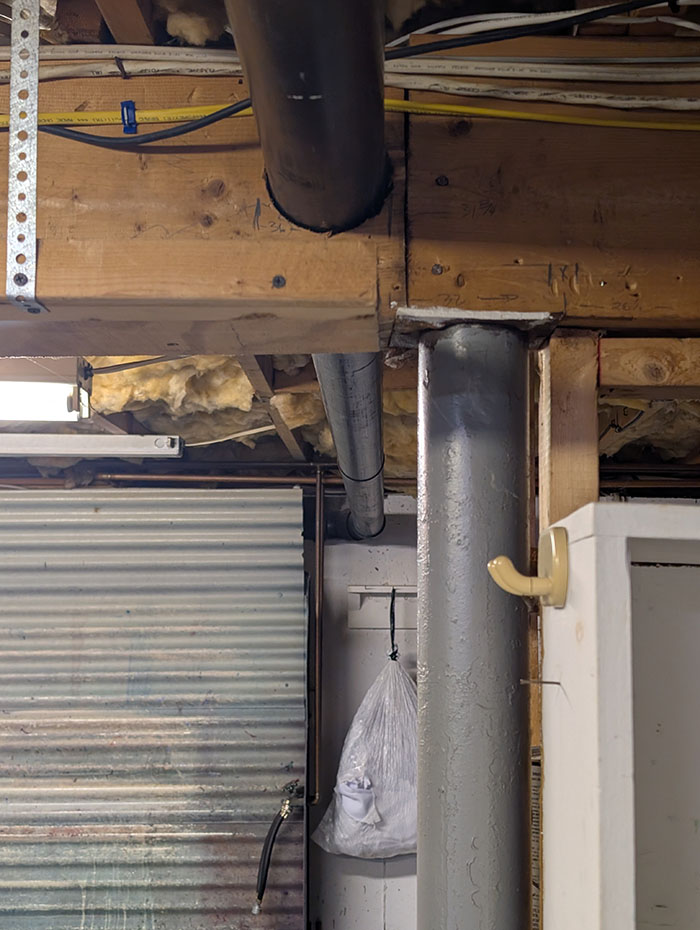
Adam shares another crazy story, this time it's about a plumber who drilled a 6-inch hole through a home's main support beam to pass a sewer pipe through the structure.
Narrator: It's time once again for the Crack Man podcast, hosted by A1 Foundation Crack Repair. I'm Darren Kincaid, and I'm here with the Crack Dad himself, Adam Tracy. Adam has 20 years of experience in the construction industry and as a civil engineer, is A1 Foundation's resident engineer on staff, solving a plethora of unique foundation problems every day. This podcast provides expert basement waterproofing, concrete repair, and preventative maintenance tips for homeowners and businesses. A1 Foundation's valuable insight will help avert the disaster of a flooded basement, health problems that are water infiltration, and protect your biggest investment, your home. The topic of today's podcast: Did a plumber really drill a 6-inch pipe through a home's main support beam?
Narrator: So, Adam, I wouldn't have believed it if I hadn't seen the picture you sent me, but did a plumber really drill a 6-inch hole through a support beam? What happened?
Adam: I don't know what happened there, but I can tell you there's always trades pointing the fingers at each other, and there's plenty of social media posts and YouTube videos to support that. But in this particular case, the plumber really screwed up on the home's structure. I'm not sure who did it or when they did it, but the homeowner, whose house is in Nashua, Southern New Hampshire, called us because they were having major issues with the first floor.
They said the floor was dipping, bending, the floorboards were coming apart, and they thought it was a huge foundation issue. They'd already had other companies come out, perform laser measurements, and tell them the foundation was way off and that there were major problems.
I asked a few questions, and eventually we discovered there was an issue with a beam. I asked, "Have you had an engineer look at this beam?" They said, "No, but we actually have an engineer coming out tomorrow to do an independent evaluation."
I said, "That's a great idea because now you're going to get an opinion from somebody who has no skin in the game. Instead of a contractor telling you everything that's wrong, you'll have an engineer evaluate the situation, and then we can determine the best way to fix it."
The engineer completed a thorough inspection and found that the foundation was actually in great shape. It was a concrete foundation with only a couple of normal settling cracks—nothing structural whatsoever.
What they did find was that this raised ranch-style home had a centre beam running down the middle of the house, supported by lally columns. All of the floor joists rested on that beam, meaning the middle third of the house, along with the second story, depended on it for structural support.
The main beam was a standard triple-laminated 2x10 beam. At some point, a plumber had cut a 6-inch hole straight through that primary structural beam so the main sewer line could pass through it.
That single hole completely compromised the beam's ability to support the house.
To make matters even worse, the hole had been cut at one of the worst possible locations—right near the end of the beam where two sections joined together directly over a lally column. Not only was the beam severely weakened, but it was weakened at one of its most critical load-bearing points.
The International Building Code (IBC) and International Residential Code (IRC), along with local building regulations, have very specific rules about drilling through structural beams. They specify how large a hole can be, exactly where it can be located, how deep it can be, and how close it can be to the ends of the beam.
Unfortunately, this installation violated just about every one of those requirements.
The good news was that the homeowner didn't have to replace the entire beam or reroute all of the plumbing.
The engineer and I agreed that we could install a properly positioned lally column directly beneath the damaged section of the beam. That additional support would restore the structural integrity of the house without requiring extensive reconstruction or replumbing.
That solution saved the homeowner tens of thousands of dollars while providing the support the house needed.
Although it was a nightmare situation to discover, the actual repair turned out to be relatively straightforward once the real cause was identified.
It took some investigation to get there, but we ultimately found the right solution, saved the homeowner a significant amount of money, and proved that the foundation had never been the problem.
So, if you notice cracks in your drywall, floor separation, or sagging floors upstairs, don't automatically assume it's a foundation issue.
Sometimes the problem is with the framing of the house. Some framing issues are hidden and difficult to spot, but in this case the cause was visible once we knew where to look.
Don't assume that every issue inside your home is connected to the foundation. Sometimes a foundation crack is simply a harmless settling crack. Other times there are genuine structural concerns.
In this case, the problem was entirely related to the framing, completely unrelated to the foundation, and fortunately it was repaired without any major issues.
Narrator: Thanks, Adam, for sharing this incredible story about a plumbing job gone wrong. Unbelievable.
Narrator: If you have a basement water problem and think you need a professional, or if you like more information on foundation crack repair and basement waterproofing topics, please visit A1foundationcrackrepair.com or call Adam at (866) 929-3171. Or you can email Adam at info@a1foundationcrackrepair.com. Thanks for listening and keep that basement dry.