

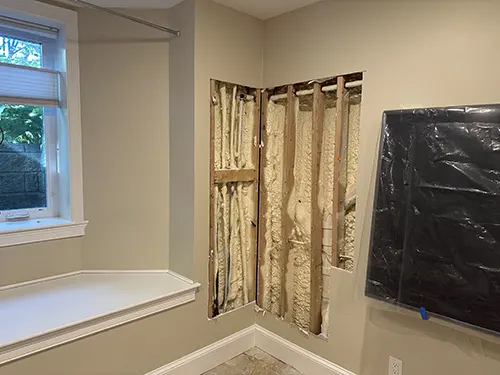
In this episode, Adam shares a case study and explains why spray foam insulation isn’t an effective method for waterproofing a basement.
Narrator: It’s time once again for the Crackman Podcast, hosted by A1 Foundation Crack Repair. I'm Darren Kincaid and I'm here with the Crack Daddy himself, Adam Tracy. Adam has 20 years of experience in the construction industry and as a civil engineer is A1 Foundation's resident engineer on staff solving a plethora of unique foundation problems every day. This podcast provides expert basement waterproofing, concrete repair and preventative maintenance tips for homeowners and businesses. A1 Foundation's valuable insight will help avert the disaster of a flooded basement, health problems from water infiltration, and protect your biggest investment, your home. The topic of today's podcast: Can spray foam insulation waterproof a basement?
Adam: So Adam, you sent over some pics of an open section of drywall that has spray foam insulation all over the interior. Yet there still appeared to be some water leaking through the dense foam. I'm guessing this isn't exactly a foolproof method for preventing water infiltration, is it?
Yeah, Darren, and this is something that we're unfortunately seeing a lot more of today, where people are looking at finishing their basements and turning it into a living space or just a room for their family to enjoy. And they're sold on doing spray foam insulation as a means to keep the space thermally insulated for the weather requirements around here.
So before you get your permit sign-off, you have to fill the envelope up and make sure that it's actually within the stretch code, and one of the quicker ways to do that is to have it spray foamed. And one of the biggest challenges with spray foam applications is that a lot of times it is sold as a means for waterproofing foundations, and that can't be any further from the truth.
The reason why it's not is that the cell structure on these spray foams is far larger than what you would have for a foam type material that's used in waterproofing. So there are materials that are used, whether injection or other ways, that look similar but are chemically very different from what is used in the spray foam world.
That whole process is intended to stop airflow and thermally insulate against air changes and temperature changes through there. What it cannot do is—it’s not a hydrophobic or hydrophilic material, meaning that it's not something that actually repels water, number one. And number two, the cell structure and the actual density of the foam is so much looser and so much fluffier, if you will, than what we would use for waterproofing, that it just doesn't do anything. So it's really there purely for insulation purposes.
The problem is that you might have somebody who's selling you on a huge basement upgrade where you're spending 75, 85, a hundred thousand dollars in a basement renovation, and this is being used as something where it is part of the waterproofing process. And the reality is, it's simply not.
So we had a particular customer here who had a finished space. It was where his in-laws lived when they were traveling up here, where they'd be three, four months at a time, usually during the summer months. And during one of the late summer rainstorms, they had water coming through in the basement.
So we kind of directed them and told them, you know, let's open up the walls, let's see how this water is coming in. Because once we know where the water is coming in, then it opens up all the tools in the playbook for us to be able to resolve the issue. When we don't know, we're all kind of guessing and we have to overshoot, but just simply opening up the walls usually gives us a better idea.
The problem here is that when you open the walls, you have, you know, six inches or five inches of foam before you even get to the foundation. So seeing where the water is coming in is impossible.
So the only way to do this is really two ways. One way is to dig out the foundation on the outside. In this case, it was totally impractical because there was only a small alleyway, about three feet, in between the house and the other property, because this property was actually inside the Boston Metro area.
The other way to do it is you chip off foam on the inside, and that can take days or weeks to get off depending on how it was applied. And then you're going to have to go back and probably reapply it at some point.
So when we're looking at these properties and you have a foundation that has been spray foamed, it's really important to understand—if you're looking at the property for buying it, or if you're looking at renovating your house and having a finished space downstairs—to make sure that this foundation is completely sealed off and making sure that there's no possible water penetration coming in different areas, because that material is simply just not going to waterproof.
And the other part of it too is that it's used a lot in stone foundations around this area. Stone foundations are notoriously difficult for any sort of waterproofing because natural stone just doesn't necessarily like to be waterproofed like a concrete foundation is.
And when you spray-apply the material onto a stone foundation, it becomes even more challenging. With a concrete foundation, we could at least pinpoint a rough area and start working from there. When it comes to a stone foundation, you have hundreds of pathways for water to come in, and where we start, it's impossible to kind of hunt it down. So it becomes a much larger project overall.
So if you are looking at finishing your basement and you are thinking about spray foam, it's a fine product and it's used in a lot of different applications for insulation purposes, but it's not a waterproofer.
So know this ahead of time and be proactive about the repairs to your foundation, because the money you spend up front as part of the waterproofing side of things is going to save you a ton of money later down the line. Eventually, water will find a way through if you have a water issue like a crack, a stone foundation, or pipe penetration that has leaks.
If you spend the money now, it's going to save you tenfold on the back end, because not only are you going to have to rip open that wall that you just finished, but then you might have to dig out the foundation, you might have to get new contractors in there to reapply everything. So it becomes a much more expensive endeavor, and generally your insurance is not going to cover any of that.
So just a word of caution: spray foam—good for insulation, bad for waterproofing. Proceed with caution and make sure that you talk to contractors about its capabilities and also about preventively waterproofing the foundation.
Narrator: Thanks, Adam, for explaining why spray foam insulation isn't an effective method for waterproofing a basement.
Narrator: If you have a basement water problem and think you need a professional or if you'd like more information on foundation crack repair and basement waterproofing topics, please visit a1foundationcrackrepair.com or call Adam at (866) 929-3171, or you can email Adam at info@a1foundationcrackrepair.com. Thanks for listening and keep that basement dry.