

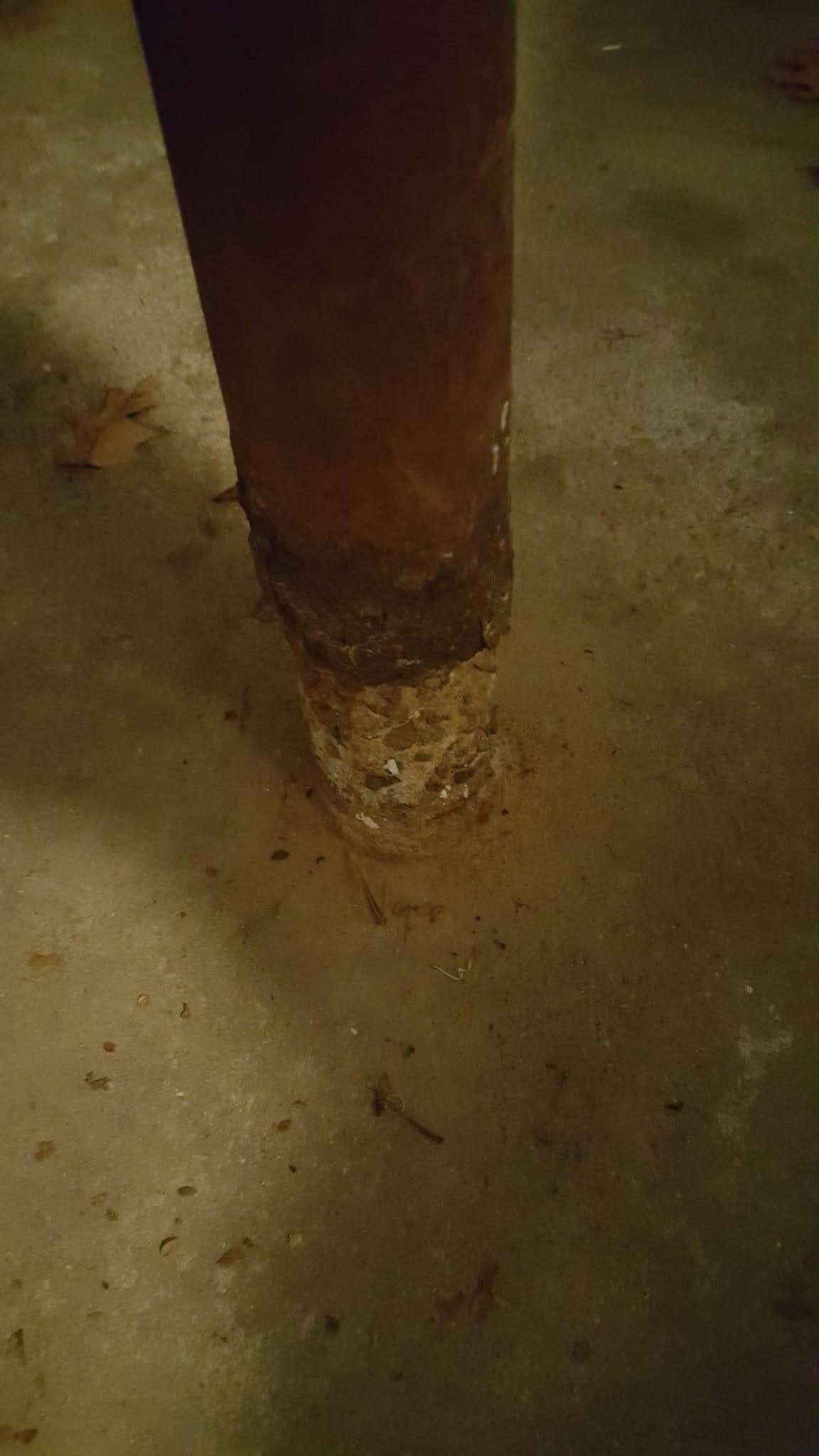
In this very cool episode, Adam explains how basement floor thicknesses are are usually not enough to support lally columns….. and he shares a little tidbit about a time capsule he ran into on the job.
Narrator: It's time once again for the Crackman Podcast hosted by A1 Foundation Crack Repair. I'm Darren Kincaid, and I'm here with the Crack Daddy himself, Adam Tracy. Adam has 20 years of experience in the construction industry, and as a civil engineer is A1 Foundation's resident engineer on staff, solving a plethora of unique foundation problems every day. This podcast provides expert basement waterproofing, concrete repair, and preventative maintenance tips for homeowners and businesses. A1 Foundation's viable insight will help avert the disaster of a flooded basement, health problems due to water infiltration, and protect your biggest investment, your home. The topic of today's podcast: Are concrete basement floors strong enough to support lally columns?
Narrator: Well Adam, interesting topic today—but you ran into a bit of a time capsule that led to it, right?
Adam: We did. You know, we work in a lot of older homes here in New England—homes that go all the way back to the 1700s, and in some rare cases, even the 1600s. When we come across concrete floors in these homes, we know they’re not always original to the structure, which in some cases has been standing for hundreds of years.
In this particular situation, we were installing a sump pump in a much older home. When the technician opened up the concrete floor, we discovered that underneath it, the ground had been layered with newspapers. These papers had actually stuck to the underside of the concrete. When we flipped the slab over, sure enough, there was an old recipe for Dutch oven chicken from the early 1950s—likely from when the floor was poured.
It was a really cool and unexpected find—a little time capsule. Most of the time, all you see under there is dirt and rocks. But what it really got me thinking about was just how thin that piece of concrete was.
That’s actually very typical in older homes where the floor was poured decades—or even centuries—after the house was originally built. A lot of homeowners ask, “Why does my concrete floor have cracks?” especially in homes that are 100 years old or more. I always explain that these floors are usually very thin.
In the Boston area—especially Metro Boston—older generations sometimes refer to these as “rat slabs.” They were commonly poured in the 1930s, 40s, and 50s to keep mice and rats from burrowing into the house and getting into the pantry.
These slabs are typically only about 1 to 2 inches thick—sometimes even less. Their purpose wasn’t structural; it was simply to create a solid surface, help with moisture control, and keep pests out, while also allowing for basic storage.
So the question becomes: even though it’s concrete—and we think of concrete as strong—is it strong enough to hold weight?
Almost every time, the answer is no.
That’s why when you install something like a lally column, building codes require a proper footing underneath. The goal is to transfer the load from the column through the concrete and into the soil below. That footing is usually 8 to 12 inches thick, sometimes more depending on the load, and it typically includes rebar reinforcement.
One of the biggest misconceptions is that concrete can hold anything. But when it’s overloaded—especially thin slabs—you’ll often see cracking. We walk into older homes all the time where someone has placed a column directly on the floor, and you’ll see circular cracks radiating around it. That’s because too much pressure is being applied to a very thin slab.
In newer homes, basement floors are thicker—usually between 3 to 5 inches, with 4 inches being typical. Even then, most of these slabs don’t include rebar; they’re just standard slab pours. While they’re stronger than old rat slabs, they’re still usually not designed to support structural point loads like columns.
They’re fine for general use—storage, foot traffic, everyday weight—but not for supporting the structure of the house.
So when people ask, “Is the basement floor structural?” The general answer is no. It can help keep walls aligned, especially if there’s inward pressure, so it does contribute in a limited way. But it’s not meant to carry the load of the house itself.
That’s why it’s important to be cautious if you see old or temporary columns sitting directly on a basement floor in older homes. There’s a good chance there isn’t enough support underneath, which could lead to problems over time.
So just keep that in mind—especially if you’re hoping that house lasts another few decades… or even another hundred years, depending on how well it was built.
Narrator: Well, thanks Adam for explaining how basement floor thicknesses are usually not enough to support lally columns—and for sharing that awesome little time capsule story. Very cool.
Narrator: If you have a basement water problem and think you need a professional, or if you'd like more information on foundation crack repair and basement waterproofing topics, please visit A1FoundationCrackRepair.com or call Adam at (866) 929-3171, or you can email Adam at info@ A1FoundationCrackRepair.com. Thanks for listening and keep that basement dry.